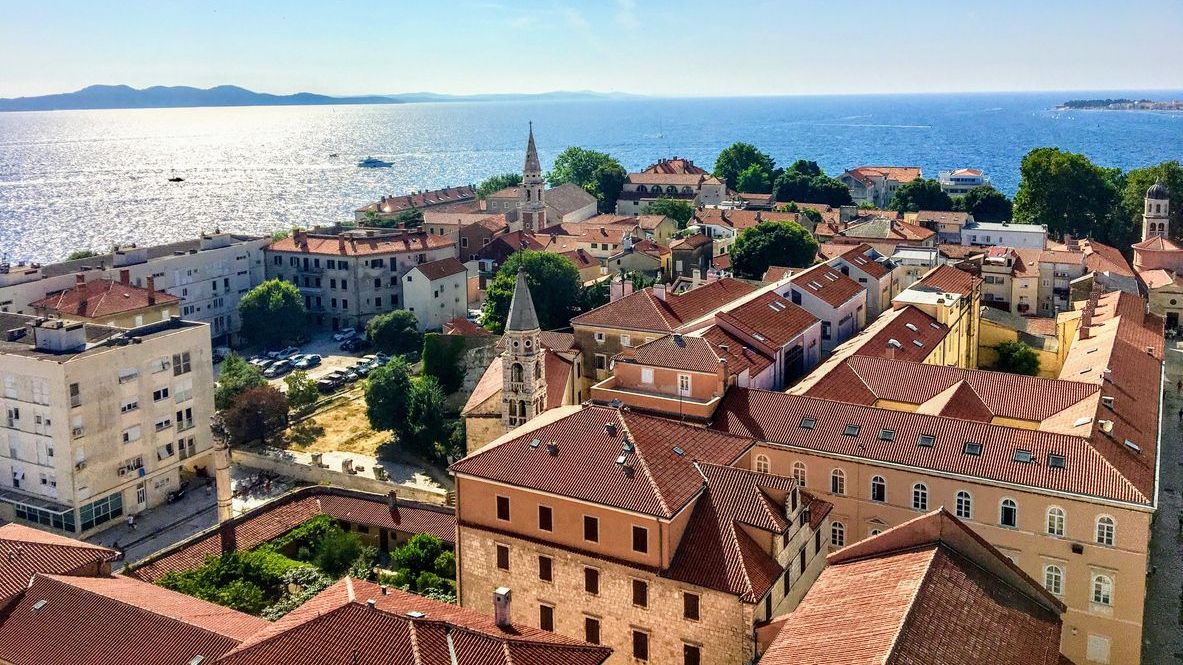
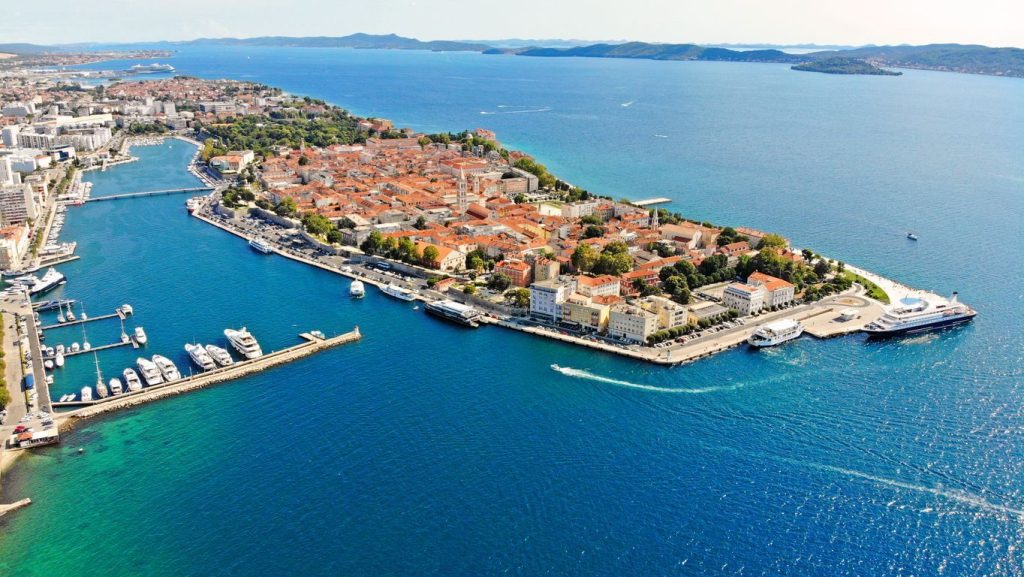
Zadar’s historical core occupies the peninsula between the harbor, the promenade, and the Adriatic Sea. This alone gives the Old Town a unique location: the sea is never far away, while narrow alleys, squares, and ancient walls lead ever deeper into the city’s past.
Those visiting the Old Town of Zadar, Croatia, move through many centuries within a small area. Roman remains, Romanesque churches, Venetian city gates, and modern landmarks lie in close proximity to one another. This does not require a strictly planned itinerary. Often, it is enough to simply start walking and be surprised by where the next alley leads.
People sit in cafés between old facades, chatter fills the squares, and the scent of coffee, pastries, or fresh bread wafts from small shops. The Zadar Old Town is therefore not a place that lives solely on its past. It feels historic but not stagnant—and that is exactly what makes a stroll here so pleasant.
Between Gates, Squares, and Ancient Walls
In the Old Town, many places worth seeing are close together, without the need to work through them like a classic checklist. Among the most striking structures is the Land Gate, which dates from the Venetian period and remains one of Zadar’s most famous historic city gates. With its stone reliefs and the Lion of Saint Mark, it serves as a reminder of the city’s former importance as a fortified site on the Adriatic.
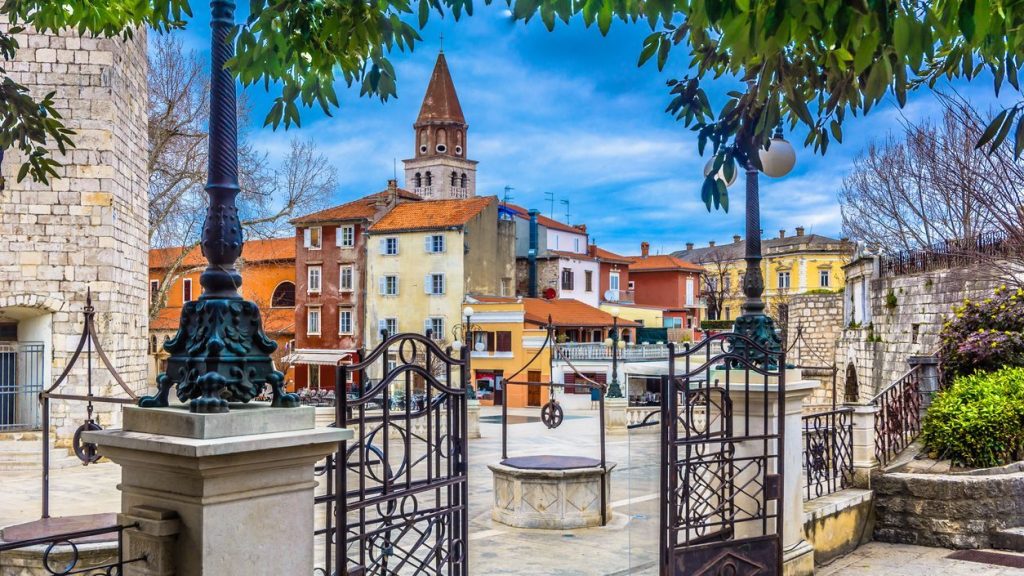
Another interesting point is the Five Wells Square. The well system was formerly used for water supply and is now one of the quieter corners on the edge of the Old Town. Located directly nearby is Queen Jelena Madijevka Park, a green area set between old walls that provides a beautiful contrast to the stone alleys and squares, inviting visitors to take a short break.
People’s Square also shapes the character of the Old Town. With the City Loggia, historic facades, and surrounding cafés, it feels less like a mere sightseeing spot and more like a place where Zadar showcases its daily life. Here, one can observe how naturally history and urban life coexist.
Zadar’s most famous sights also include the Roman Forum, the Church of Saint Donatus, and the Cathedral of Saint Anastasia. The Forum points to the city’s Roman origins, St. Donatus immediately catches the eye with its round shape, and the cathedral’s bell tower offers a wide view over rooftops, the sea, and islands. Those interested in culture and history will find many points of interest in this part of the Old Town.
An Old Town Stroll Between Alleys and the Sea
A walking tour through Zadar’s Old Town does not have to follow a fixed route. You can start at the Land Gate, continue across the Five Wells Square toward People’s Square, and then slowly drift toward the Kalelarga. This street is one of the most famous places in the Old Town and leads you right into the heart of city life.
On the Kalelarga, shops, cafés, and small branches into quieter side streets alternate. Locals go about their errands, while travelers admire the displays in the shop windows or enjoy a coffee in the sun. Consequently, the street does not feel like a mere tourist attraction, but like a piece of everyday life in the middle of the Old Town.
The closer you get to the Forum, the more the historical layers emerge. Suddenly, Roman stones stand next to church walls, and old facades next to modern cafés. Zadar reveals its history not in a single location, but gradually—at corners, passages, squares, and walls.
To conclude, a walk to the waterfront promenade is well worth it. There you will find the Sea Organ and the Greeting to the Sun, two modern landmarks that provide an atmospheric finish to a tour of the historic city center. In the evening, both places take on a different effect: the waves set the tone while the light installation slowly begins to glow and the sun disappears behind the sea. Thus, the tour does not end abruptly but transitions peacefully into the evening.
Roman Stones, Venetian Gates
Those interested in history, architecture, ancient urban structures, and various cultural influences will discover a surprising amount within a small area in the Zadar Croatia Old Town. There is more to see here than just a single monument or a specific era. Rather, Roman, Venetian, Romanesque, and later traces overlap in the cityscape.
The Roman past is most evident around the Forum. There, column fragments and stone blocks lie open in the cityscape, directly next to later churches and residential buildings. As a result, the square does not feel like an artificially staged setting, but like a part of the city that simply continues to exist.
The Venetian era is primarily recognizable by the fortifications and city gates. The Land Gate from the 16th century is the most striking example of this. It serves as a reminder that Zadar played an important role in the Adriatic for a long time and had to be well protected. Parts of the city wall also tell of this period and continue to provide the Old Town with its clear framework.
In between, one finds Romanesque, Gothic, and Baroque elements that further define the cityscape. This mixture makes the tour particularly interesting: one moment your gaze falls on an old stone relief, the next on an archway, a church facade, or an inner courtyard. In Zadar, it is therefore worth not only following the major sights but also paying attention to the smaller architectural details.

Culinary Delights, the Market, and Small Discoveries
After a tour of the Old Town, it is worth taking a break in a konoba, a café, or a small restaurant. Dalmatian cuisine is strongly influenced by the sea but is not limited to fish. On many menus, you will find calamari, mussels, grilled fish, olive oil, herbs, vegetables, and simple dishes that deliver great flavor without much fuss.
Typical of the region are, for example, black risotto with squid or cuttlefish, peka with meat or seafood and potatoes, and brudet, a hearty fish stew often served with polenta. These are perfectly accompanied by Dalmatian ham, cheese from the island of Pag, fresh bread, and a glass of regional wine.
Zadar’s market is also worth a visit if you want to get to know the city from a more everyday perspective. Between fruit, vegetables, fish, cheese, and olive oil, you quickly get a sense of which products are important to the region. It is a great place to discover local ingredients, pick up small purchases, or simply stroll through the morning market bustle for a few minutes.
The Old Town also offers plenty of opportunities for small gifts. Around the Kalelarga and in the side streets, you will find boutiques, jewelry, handicrafts, local products, and souvenirs. It is not a classic shopping district, but rather a place for browsing, looking, and discovering things along the way.
Experiencing the Old Town in Peace
The Old Town of Zadar unfolds its charm best when you do not try to do too much at once. A coffee at People’s Square, a look at the Forum, a stroll to the promenade, or a dinner in a small alley are often enough to get a good feel for the city.
If you are still looking for suitable accommodation for your trip to Zadar, Dalmatien Haus is happy to assist you. We offer vacation homes, villas, and apartments in Dalmatia, including accommodations by the sea, with a pool, or with space for families and groups. This provides you with an excellent starting point to explore Zadar’s Old Town and the surrounding area at your own pace.